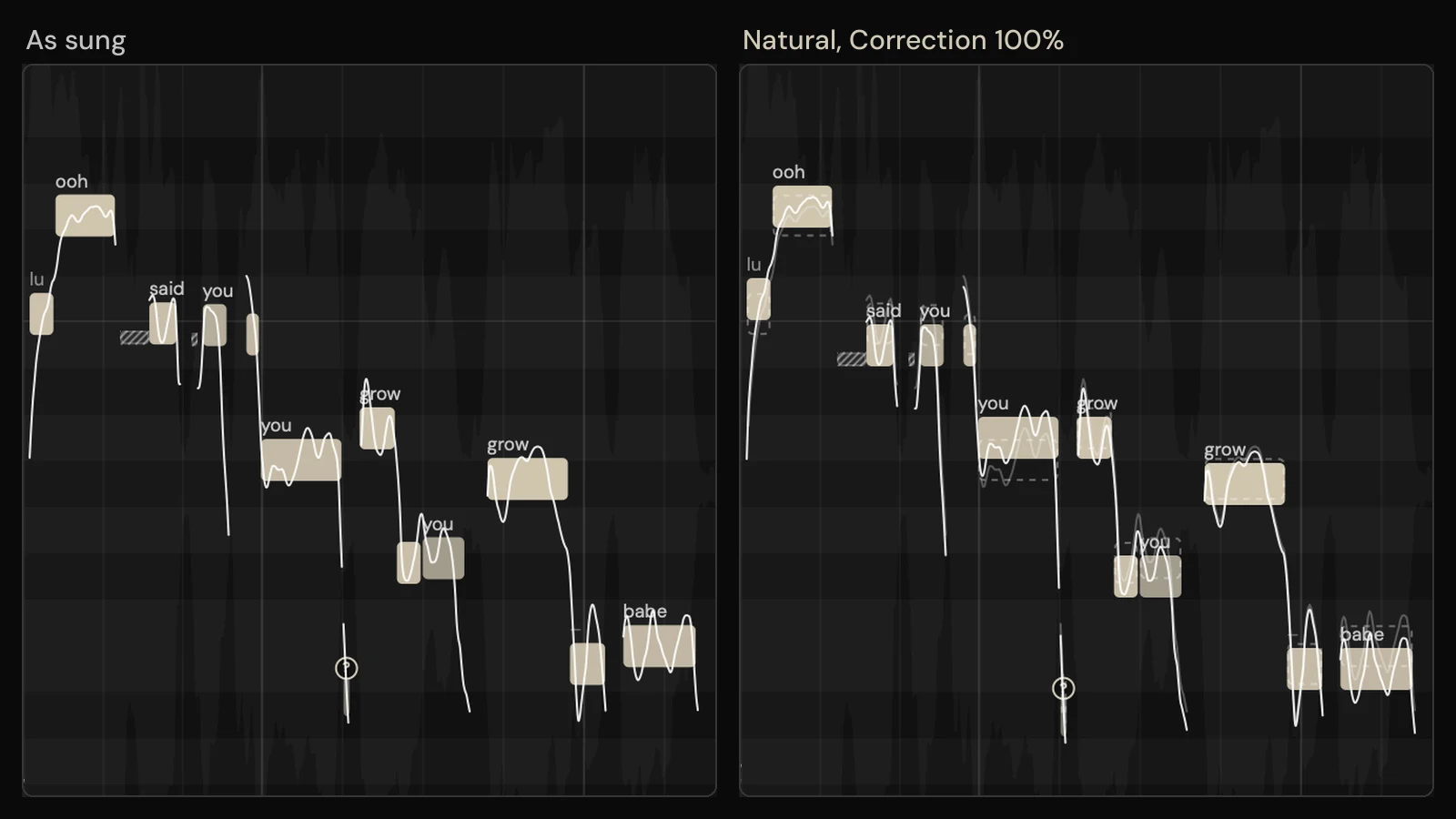
A vocal can be perfectly in tune and no longer sound like the person who sang it. Tuning itself is rarely to blame. Usually the tuner corrected the wrong part of what the voice was doing.
What happens inside a note
Zoom into a sung note and it is never a flat line. There is a centre, the pitch the singer meant, and the voice moves around it. Most notes start a little below or above the centre and slide in. Many have vibrato, a swing of five to seven times a second. Long notes drift: they sag a few cents as the breath runs out, or creep up when the singer pushes. And the end of a phrase lets go.
That movement is a big part of how you recognise a singer. When a vocal sounds tuned, it is usually because every moment of it was pulled onto the note, and the movement went out with the error.
Correcting the centre
If a singer aimed for an A and landed twenty cents flat, the only thing wrong is where the centre sits. Move the centre up twenty cents, bring everything around it along, and the slide, the vibrato and the drift are still there, now around the right note.
That is what Natural does in Intonic Vocal. Correction at 100% puts each centre on its note; lower settings leave some of the original tuning in. Vibrato and Drift have their own sliders, for the long note that wobbles more than it should.
Most takes have only a handful of notes that need help. Select those, leave the others as sung, and switch between Edited and Original while it plays to hear what you changed.
Formants
The other half of a voice is its colour: the resonances of the throat and mouth, called formants. They stay put when a singer goes higher, because the singer's head stays the same size. Shift a note up a fourth by speeding the sound up and the formants go up with it. That is why a big move can sound like a smaller, younger person. A pitch editor should leave the formants where they were, and still let you move them on purpose for a brighter or darker voice.
I measure this rather than judge it by ear. I move notes by a semitone, two, a fourth and a fifth, and compare each result with the same singer actually singing that note. Intonic Vocal came closest in all four, by a small and steady margin. The numbers are on the home page.
When the robot is the sound
None of this applies when you want the effect. Hard tune at 0 ms puts every moment on the note, and on plenty of records that is exactly right. How fast the pitch gets there is a post of its own, on retune speed.