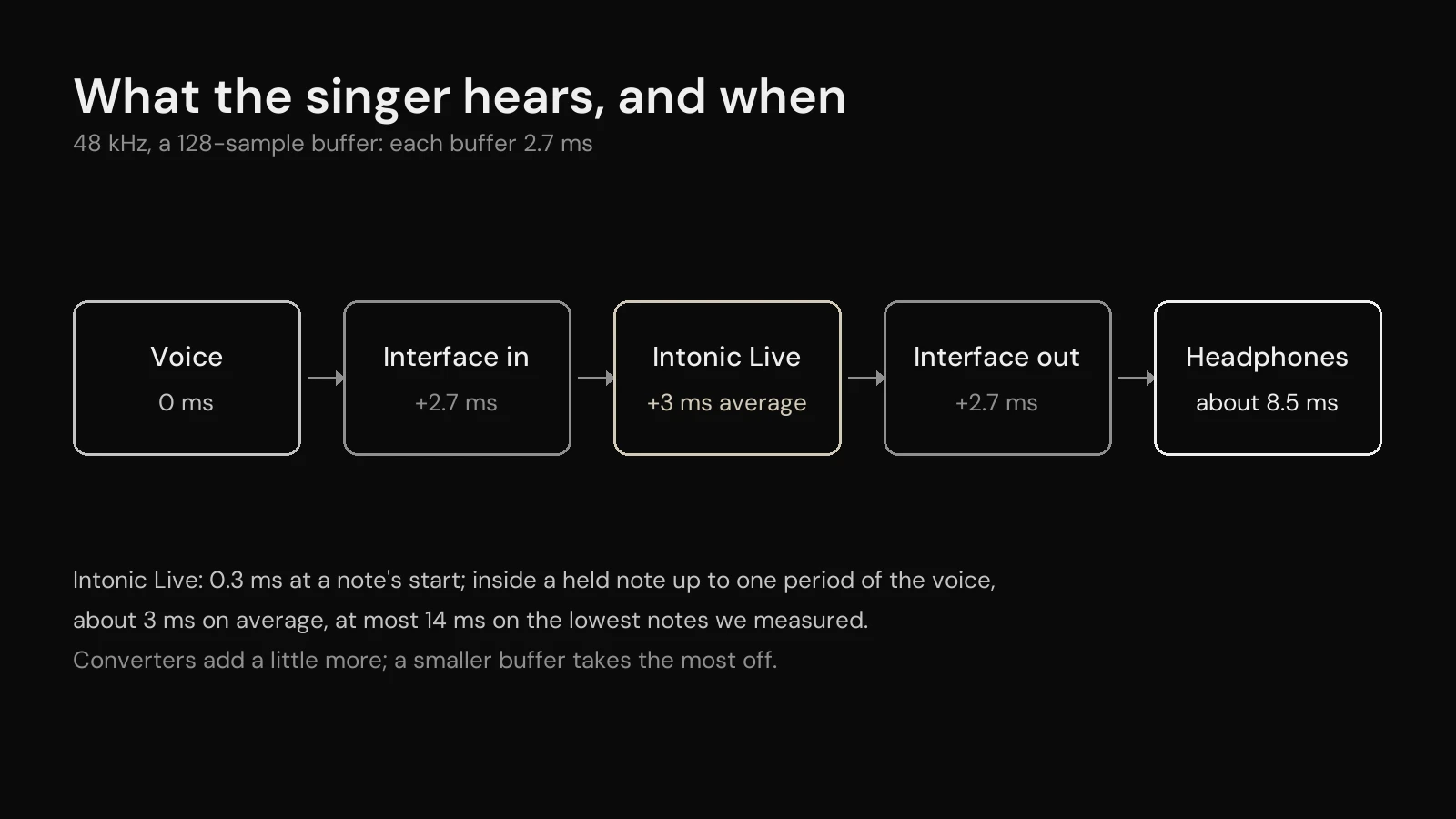
With a real-time tuner on the vocal track, the singer hears the tuned voice in their headphones while they record or perform. That only works if the voice comes back quickly. When it lags, singers feel it long before they can say what is wrong.
Where the delay comes from
Two things make the headphone signal late. The interface and the computer move audio in small blocks, the buffer, once on the way in and again on the way out. And the tuner needs to hear a little of the voice before it knows the pitch.
The buffer is usually the bigger part. At 48 kHz, 64 samples is about 1.3 ms, 128 samples about 2.7 ms and 256 samples about 5.3 ms, paid in each direction, plus a little for the converters. That is the reason to track at a small buffer and mix at a large one.
Why low notes take longer
A tuner has to hear at least part of one cycle of the wave to know its pitch. One cycle lasts about 2.3 ms at 440 Hz, about 5 ms at 200 Hz, and more than 12 ms on the lowest notes of a bass voice. However the tuner works, a low note gives it less to go on per millisecond than a high one.
In Intonic Live a note's start comes out 0.3 ms after it is sung. Inside a held note it can take a little longer, more on low notes than on high ones. Across the 40 songs and four takes I measured, it averaged about 3 ms behind the voice and was never more than 14 ms, on the lowest notes. The best-known tuner, in its low-latency mode, is 3.5 ms at a note's start.
Keeping monitoring tight
Track at 64 or 128 samples if the computer keeps up. Put the tuner on the track the singer monitors and record the voice as sung: most DAWs record a take before the track's effects, so the tuning can still change later. On stage, keep the chain short, microphone to interface to tuner to in-ears, because every extra hop adds its own buffer.
Intonic Live reports no latency to the DAW. Its output is simply the voice a few milliseconds late, with no lookahead for the DAW to make up, so nothing on the track gets moved.