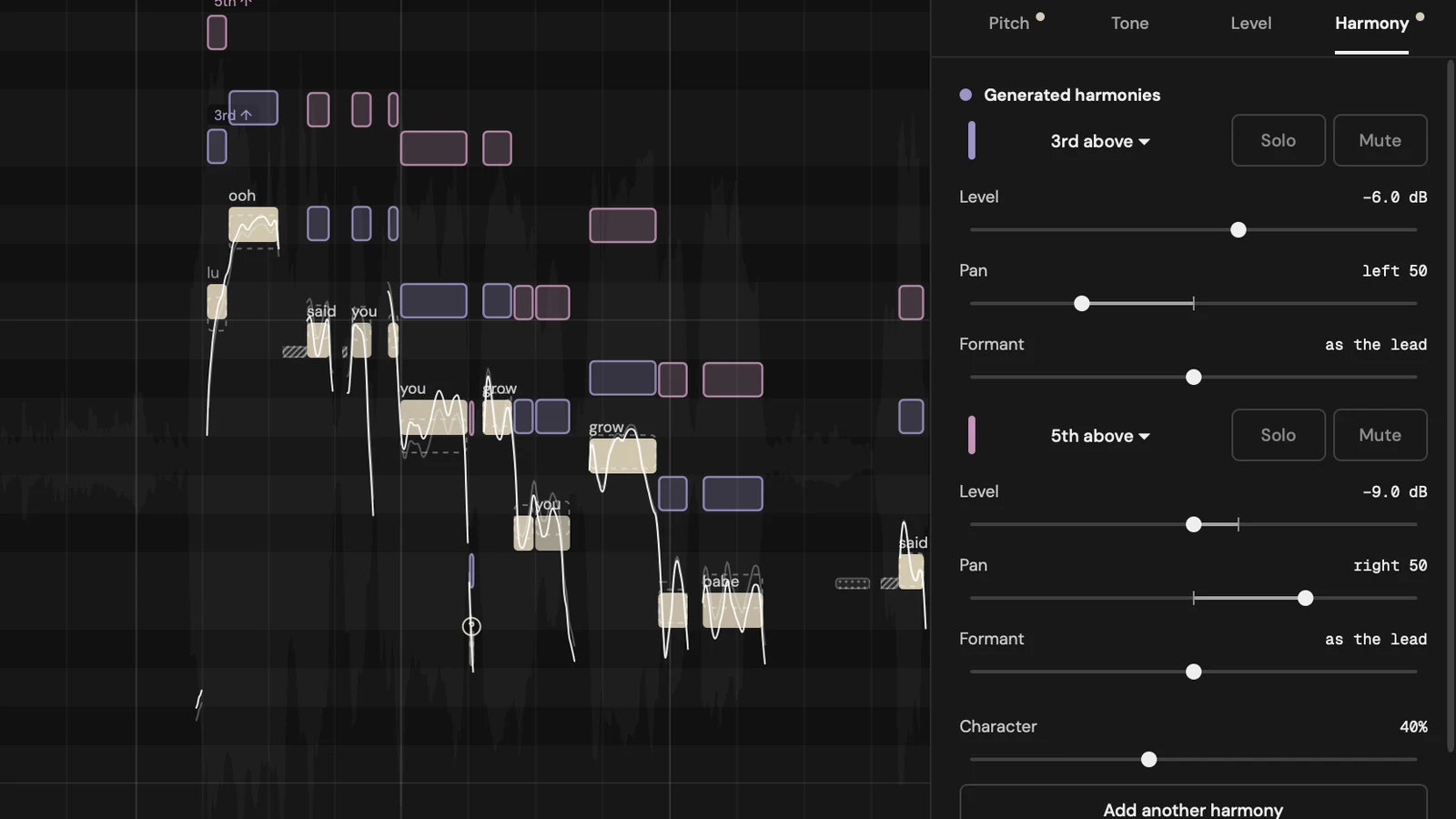
Backing harmonies a third above the lead are everywhere in pop. Recording one properly takes a second singer, or the same singer twice, and an afternoon. Making it from the lead take is quicker, and it can sound right if you avoid the three things that give generated harmonies away: wrong notes, perfect timing, and the lead's own colour.
Wrong notes
A third above C is E in C major and E flat in C minor. A harmony that always adds the same number of semitones will be right on some notes and clash on others. Count the interval through the song's key instead, from each note: a third above means two scale steps up, wherever the lead is. That is how Intonic Vocal builds them, which is why it needs the key first. It offers the key it found in the take.
Even counted through the key, not every note wants a harmony. Passing notes, blue notes and notes held across a chord change are the usual trouble. Solo the harmony once and fix those: any harmony note can be moved, stepped or taken out on its own, and when you change a lead note its harmonies follow.
Perfect timing
Backing singers come in a touch late, sit a few cents apart and never hit a consonant at the same instant as the lead. A harmony made from the lead does all of that perfectly, and the ear notices. Character in Intonic Vocal puts some of it back: the harmonies arrive a little late, a few cents apart.
The lead's colour
A third above, made from the lead, has the lead's voice moved up. Give each harmony its own Formant setting so it sounds like another person rather than the same one higher. Up to four harmonies can come from one take, each with its own Level, Pan, Formant, Solo and Mute.
Mixing them
Start the harmonies about 6 dB under the lead and set them by ear. A third on one side and a fifth on the other makes a wide chord with the lead in the middle; a third alone, close and centred, is the classic country and pop sound. When they are right, drag them out to the DAW, together on one track or each on its own, so they can get their own EQ, compression and reverb.